




 Whitman Expo
-
Commonwealth of Australia Currency & Banknote Values
Banknote Book® Price Guide


Sort by
Sponsor

Sponsor

Sponsor

Sponsor

Sponsor

Legal Disclaimer
The prices listed in our database are intended to be used as an indication only. Users are strongly encouraged to seek multiple sources of pricing before making a final determination of value. CDN Publishing is not responsible for typographical or database-related errors. Your use of this site indicates full acceptance of these terms.
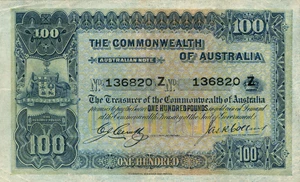
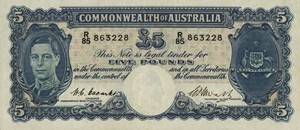
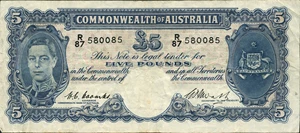
The Greysheet Catalog (GSID) of the Commonwealth of Australia series of Australia in the World Currency contains 147 distinct entries with CPG® values between $6.00 and $45,000.00.
When the six separate British self-governing colonies of New South Wales, Queensland, South Australia, Tasmania, Victoria, and Western Australia agreed to unite and form the Commonwealth of Australia (COA) on 1 January 1901, the Australian parliament assumed power to make laws with respect to banking and currency, and was keen to have a nationally-acceptable currency. The passing of the Australian Notes Act of 1910, which assigned responsibility for the issue of banknotes to the Commonwealth treasury, made it an offense for any bank to circulate banknotes issued by a state and withdrew their status as legal tender. Further, the issuing of banknotes by private banks was effectively discouraged by the Bank Notes Tax Act, also of 1910, which imposed a tax of 10 per cent per annum on all banknotes still circulating.
In 1911, the first Commonwealth Bank Act gave the Commonwealth Bank of Australia only the ordinary functions of commercial and savings banking; the bank did not specifically have a central banking remit and it was not responsible for the note issue. Management of the bank was vested in the governor. The bank opened for business in mid-1912. At that time, the note issue was administered by the Australian Department of the Treasury, which had taken it over from the private trading banks and the Queensland government.
In 1920, responsibility for the note issue was transferred from the treasury to a Notes Board (consisting of four members, appointed by the government). The governor of the bank was ex officio a member of the Notes Board. The administration of the note issue was undertaken by the bank, though the bank and the Notes Board were formally independent of each other.
In 1924, the Commonwealth Bank Act was amended and the Commonwealth Bank of Australia was given control over the note issue. The Reserve Bank Act 1959 preserved the original corporate body, under the new name of the Reserve Bank of Australia, to carry on the central banking functions of the Commonwealth Bank, which had evolved over time; other legislation separated the commercial banking and savings banking activities into the newly created Commonwealth Banking Corporation.
See More See Less






Sponsor


Sponsor


Sponsor


Sponsor


Sponsor


 Loading more ...
Legal Disclaimer
The prices listed in our database are intended to be used as an indication only. Users are strongly encouraged to seek multiple sources of pricing before making a final determination of value. CDN Publishing is not responsible for typographical or database-related errors. Your use of this site indicates full acceptance of these terms.
Available on Greysheet Marketplace
View All
Auction Ends: 11/1/2026
Auction Ends: 11/1/2026
Auction Ends: 11/1/2026
Auction Ends: 11/1/2026
Dealer Directory
View All Dealers





Greysheet News
View All News

The Reserve Bank of New Zealand have released a new range of collector coins in celebration of the Paris Olympics.


The Croatian National Bank issue new gold and silver collector coins in the Croatian Heritage series.
The unprecedented crossover underscores his personal efforts to combat “grade inflation.”
Events
View All Events


Rothchild Catering & Conference Center

Saturday, August 1, 2026

Coinacopia Building
Saturday, August 1, 2026

Fort Mason Gallery 308 Building A
Saturday, August 1, 2026